
 Virtual café
Seven ways to explore AI, put ideas to the test and review results.
01Learning exercise · Synthetic dataWhat can we learn from 300 synthetic records?My first AI and Google Colab analysis practice: calculating, interpreting and checking results.Open practice
Synthetic data
Context
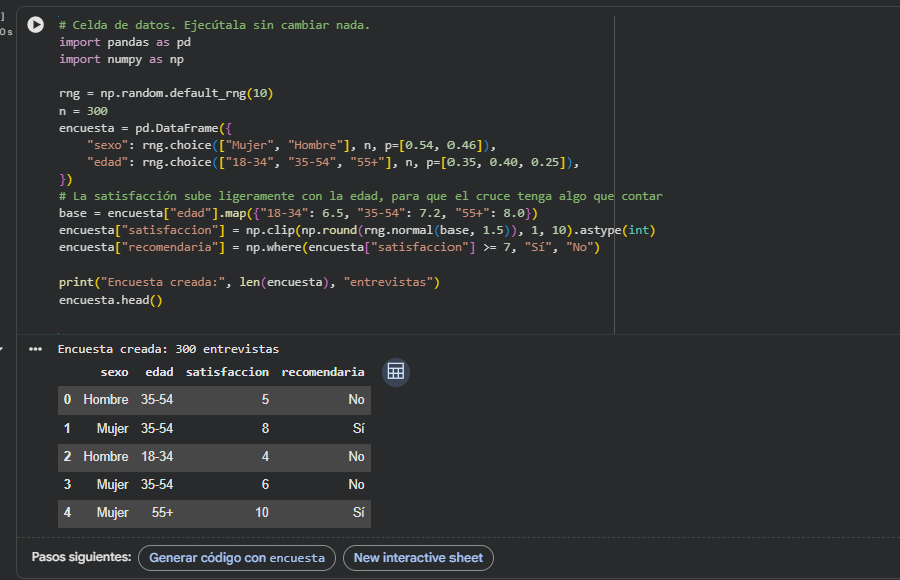
A learning exercise using 300 synthetic records generated by code supplied in the course: Curso Práctico de Inmersión en la IA para Investigadores de Mercados, 10.ª edición, de Insights + Analytics España. This page documents Exercises 3 and 4.
What I wanted to find out
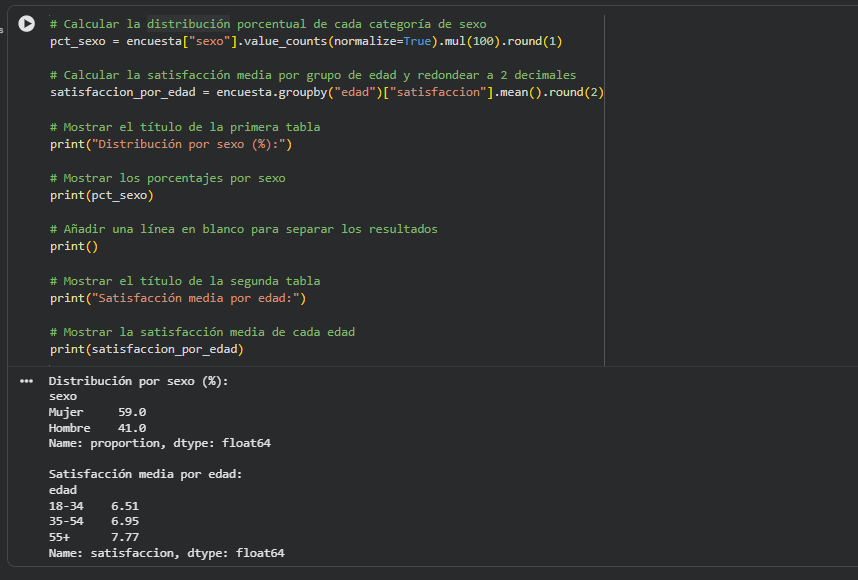
Summarise a table of 300 records: distribution by sex and average satisfaction by age group.
Method
- Define the calculation and understand the concepts
- Generate code with AI assistance
- Run it in Colab
- Review the results
- Represent them in a chart
Practice evidence
Results
Distribution by sex
Share of the 300 synthetic records.
| Group | Percentage |
|---|---|
| Women | 59 % |
| Men | 41 % |
Average satisfaction by age
Average score out of 10. It is not a percentage of people.
| Age group | Mean (out of 10) |
|---|---|
| 18–34 | 6.51 |
| 35–54 | 6.95 |
| 55+ | 7.77 |
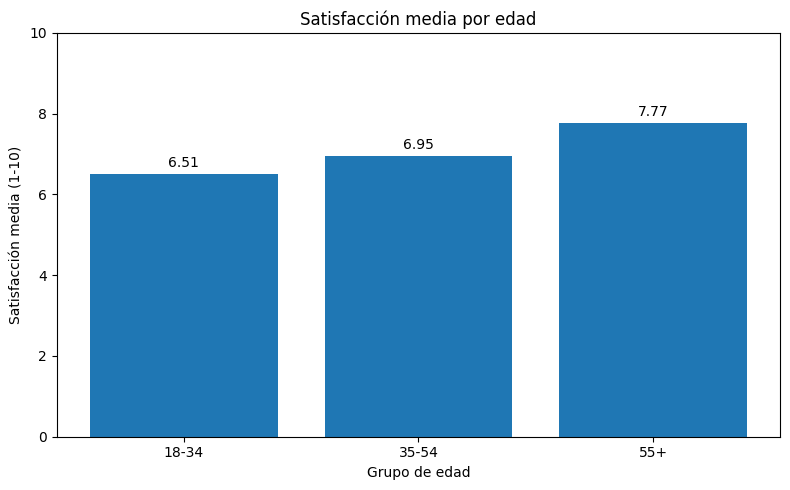
Learning exercise using 300 synthetic records. The higher satisfaction trend by age was built into the data generation. It is not a finding about real customers.
Interpretation and limits
Reading the results
I kept the indicators distinct according to what they describe: the percentage distribution shows the composition of the records, while the averages summarise ratings for each group. The chart makes them comparable on the same scale.
02 Interactive exercise · Fictional scenarioPrompt ControlHow a response changes when the way we ask changes. Open practice
This Prompt Control case uses a fictional situation and contains no real customer or company data.
What I want to observe
I make the same request five times, adding one more layer each time, and compare how the answer changes. The underlying idea: working well with AI isn’t about asking a question, but about preparing the brief well.
How I test it
- 1 · Just the question
- 2 · + who it’s for and why
- 3 · + tone, format and limits
- 4 · + an example of what I expect
- 5 · + “check before you answer”
- I compare the 5 answers
English translation of the original exchanges in Spanish.
Step-by-step example · ChatGPT, each version in a new chat
Case: a review from Marta, a regular customer whose order arrived five days late without anyone letting her know.
Version 1
What I asked
“Reply to this review.”
What it replied
“Hello Marta, we’re very sorry about the delay and, above all, for not letting you know that your order would arrive later than expected. We understand your disappointment, especially after so many years of trusting us. Thank you for letting us know. We’ll review what happened to prevent it from happening again and improve our communication whenever there is a delivery issue. We hope to regain your trust the next time you shop with us.”
Version 2
What I added
Who it’s for and why: “It’s Marta, a regular customer of an online shop. The goal is for her to feel heard and trust us again.”
What it replied
“Hello Marta, we’re very sorry about the delay and, above all, for not notifying you in time. We completely understand your disappointment, especially after so many years of trusting us. We appreciate you telling us about it. We’re going to review what happened to prevent it from happening again and improve communication whenever there is an issue with an order. We hope to regain your trust with your next purchase.”
Version 3
What I added
Tone, format and limits: “Warm and sincere tone, no excuses or stock phrases. Four sentences at most. Don’t offer discounts.”
What it replied
“Marta, I’m sorry your order arrived five days late and that we didn’t let you know. I understand that you’re disappointed, especially after so many years of shopping with us. We’re going to review what went wrong with tracking the order and notifying you of the delay. We want to regain your trust with a better experience.”
Version 4
What I added
An example of the style I want, taken from another case: “Javier, you’re right: the product wasn’t what we showed in the photo. We’ve already corrected it on the website so it doesn’t happen to anyone else. Thank you for letting us know in such detail.”
What it replied
“Marta, you’re right: besides the delay, we should have told you that your order wouldn’t arrive on time. We know you’ve trusted us for years and understand that we’ve disappointed you this time. Thank you for telling us; we’ll review what went wrong with communication to prevent it from happening again.”
Version 5
What I added
A review before replying: “Check your draft: that it doesn’t promise anything we can’t deliver, doesn’t sound templated and addresses what bothered her most.”
What it replied
“Marta, you’re right: the worst part wasn’t just the five-day delay, but that no one let you know. After so many years of shopping with us, we understand your disappointment all the more. Thank you for pointing it out so clearly; we’ll review how we communicate these kinds of issues to prevent it from happening again.”
Each version adds one layer to the previous one.
The human role
Compares the answers and weighs which one best fits what was needed, and why.
Lessons learned
Context alone barely changed the reply. Defining the tone and length, and giving an example, improved it. The final review focused on what upset Marta most: no one had warned her. It still needed one last human edit.
03 Conceptual proposalResearch FlowWhich parts of research can be automated while preserving interpretation. Open practice
What I want to observe
How far the machine can go in sorting things out, and where the work of understanding begins. A pattern is a clue, not necessarily the explanation.
How I test it
- Customer comments
- Automatic classification
- Thematic grouping
- Pattern detection
- Hypotheses
- Human review
The human role
Reviews the hypotheses, checks them against the context and decides what deserves deeper research.
Lessons learned
Organising information and understanding it are different jobs. Context still needs interpretation.
04 Conceptual proposalHuman in the loop (HITL)Where automation fits and when a person needs to intervene. Open practice
What I want to observe
Which tasks can run on their own, and at what point a human review prevents costly mistakes later on.
How I test it
- Input
- AI processes
- Human validation
- Continue · Correct · Stop
The human role
Decides at the validation point: whether the result moves on, gets corrected or stops.
Lessons learned
A workflow needs review points where a person can correct it or stop it.
05 Conceptual proposalAI Quality CheckHow to avoid accepting an answer simply because it sounds confident. Open practice
What I want to observe
That a well-written answer is not the same as a reliable one, and which checks help tell them apart.
How I test it
- AI generates an answer
- Second review layer: sources, contradictions, errors and biases
- Confidence level
- A person decides whether it holds up
The human role
Reads the review and decides whether the answer works, needs changes or is discarded.
Lessons learned
The content and sources need checking, alongside how the answer is written.
06 Conceptual proposalAI vs AIWhat happens when one AI questions or checks another AI’s response. Open practice
What I want to observe
Whether disagreement between agents helps reveal blind spots… or just adds noise.
How I test it
- One agent proposes an interpretation
- Another agent challenges it: looks for flaws and alternative explanations
- Weighing the arguments
- The final decision is human
The human role
Listens to both agents, weighs their arguments and makes the final decision.
Lessons learned
Two different answers raise questions. Their disagreement does not by itself prove which is correct.
07Interactive exercise · Static screenshotModel ChoiceReading benchmarks with judgementWhich model should I choose for a task?Open practice
Read a benchmark snapshot, distinguish its metrics and check what we can conclude from them.
Choose according to the task
A simple task may need speed. A repetitive task may make cost more important. And a complex task may justify sacrificing both.
Snapshot from October 2026. It does not update in real time.
Speed measures output tokens per second. Cost per Task is the benchmark’s weighted average cost, not a guaranteed price for your own task.
Four questions to explore the snapshot. You can change your answer.
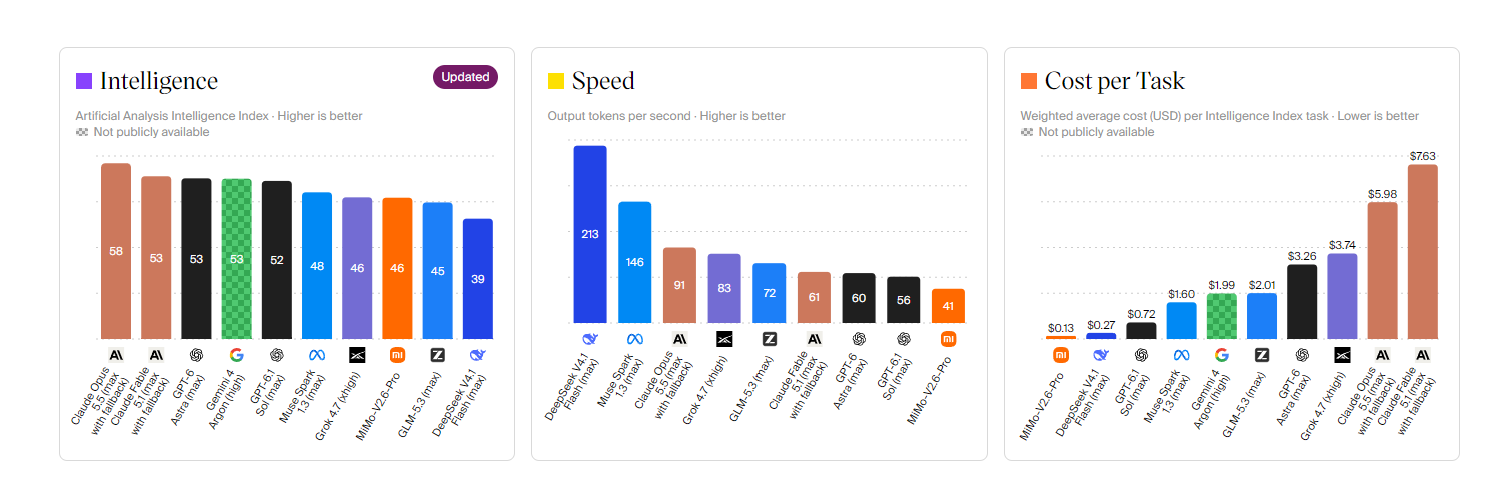
According to the snapshot, which generates the most tokens per second?
Which has the lowest Cost per Task in this snapshot?
Among these three options, which has the highest Intelligence score?
Can these charts identify the most efficient model for every task?
Faster, cheaper and more suitable are different questions. The decision starts by defining what we need to obtain.